The weekly review is where trust gets rebuilt
Most abandoned systems aren't abandoned. They're just quietly disbelieved.
You can tell because the app still opens every morning. You still glance at it. But somewhere along the way it stopped being the thing you act from and became a thing you look at, the way you look at a noticeboard in a building you no longer work in. There's a project in there with no next action that you've stepped over so many times it's furniture now. There are three "next actions" that were superseded a fortnight ago. There's a dated item from last month sitting in a colour that used to mean "urgent" and now means nothing, because you've trained yourself not to see it.
Nothing dramatic broke. You didn't rage-quit. You stopped believing the list, and a list you don't believe is worse than no list, because it costs you the glance and gives you nothing back.
What the weekly review is for
This is the thing the weekly review is actually for, and almost nobody describes it this way. It's not about being productive on a Sunday. It isn't a moral test of whether you're the sort of person who reviews things. It's much more boring and much more useful than that. It's maintenance on an agreement. You and your system have a deal: you put things in, it holds them faithfully, you don't have to carry them in your head. The review is when you check the deal is still being honoured both ways. The point of an hour on Sunday isn't Sunday. It's that Monday's list is credible again.
Why it's so easy to skip
I'll admit the obvious thing, because pretending otherwise helps nobody. The review is extremely easy to skip. It has no deadline. Nobody's waiting on it. Skipping it costs you nothing visible this week, which is exactly why it decays. The bill turns up later, as that slow loss of faith, and by then it doesn't feel like a missed review, it feels like the tool not working.
What a useful review asks
When you do sit down to it, the useful version is mostly a run of plain questions, not a reorganisation. What's piled up in the inbox that you never processed? Which projects have no real next action, which means they're not projects right now, they're wishes? Are the areas still the areas, or has life moved on? What's genuinely waiting on someone else, and have you been sitting on something you think you delegated but didn't? Which dated commitments are real, and which were optimism with a calendar attached? What's in someday/maybe that you can honestly admit is never, and say so, and let go of? And the one people skip: what in here makes your chest tighten when you look at it, because that's usually the thing the whole system has been quietly bending around.
When the review becomes avoidance
Now the trap, because there's always a trap. The review can become its own form of avoidance. There's a kind of person, and I have been this person, who'll spend ninety minutes lovingly recolouring tags and renaming projects and end with a system that's beautiful and contains exactly as many open loops as when they started. That isn't a review. That's a museum, curated. A good review ends with fewer things demanding your attention, not the same things arranged more attractively. If you finish and the list isn't shorter or clearer, you reorganised. You didn't review.
It's a bit like a workshop. The point of putting tools back on the wall isn't tidiness for its own sake. It's that next week you reach for the chisel without thinking and it's there, so you trust the wall enough to stop checking. A workshop you have to re-survey every time you need something isn't a workshop, it's a pile with ambitions. The person who spends Saturday polishing tools they never use has missed the point just as badly, mind, only from the other direction.
Structured, but light
Our bias, stated plainly: a review should be structured enough that you don't have to remember the ritual, so the tool walks you to the places neglected commitments actually hide, but light enough that skipping a week is a minor lapse rather than a personal failing. We took that second half seriously. A brand-new project, for instance, shouldn't demand to be reviewed the day you made it. That's the system nagging you for no reason, and a system that cries wolf in week one is a system you'll have tuned out by week six.
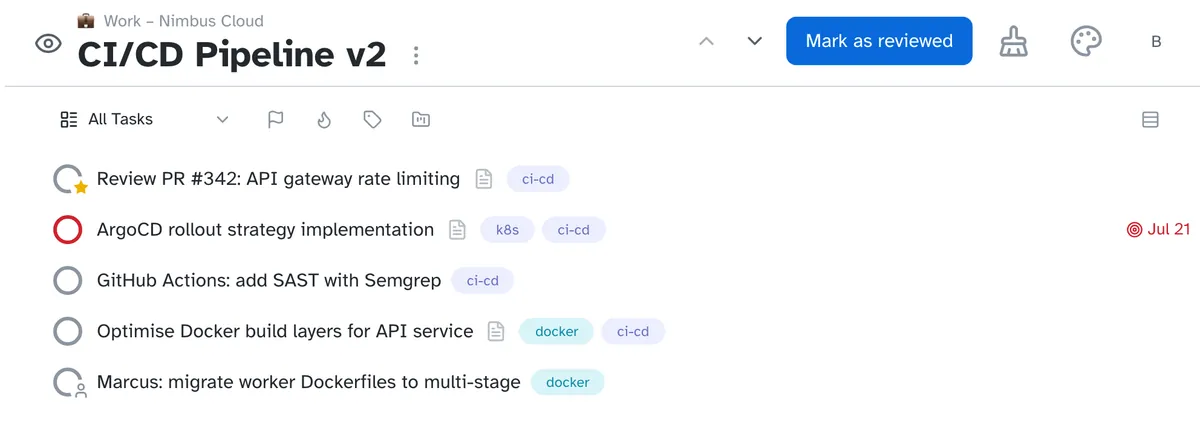
That's the only place I'll mention the product, and only as an example of the bias, not a pitch. Irkless has a built-in Review flow, and it steps through your projects and areas rather than dropping you in front of everything at once. Not because stepping is clever, but because that's where the rot is. Orphaned commitments don't hide in your inbox; the inbox is loud, you deal with it. They hide one level down, in the project that hasn't had a next action since March and that you've successfully avoided looking at directly ever since.
Do you need one at all?
The honest counter-argument: plenty of people keep a trusted system with no formal review at all, because they process continuously and their loops never get the chance to pile up. If that's you, genuinely, don't manufacture a ritual to feel virtuous. The goal was always trust, not doctrine, and you already have it.
But if the disbelief I described at the top landed a little too cleanly, if you recognised the noticeboard in the building you don't work in anymore, here's the cheap experiment, and it pays out whatever tool you end up using. Before you go shopping for a new app, which is the productive-feeling way to avoid the actual work, do one deliberately boring review of the system you already have. No new software, no migration, just the plain questions and the discipline to finish with a shorter list than you started. If your system comes back to life, a different one was never going to save you. And if it doesn't, you'll at least go looking knowing what you actually need, which is worth more than any feature comparison. Your list is only useful if you believe it. Everything else is downstream of that.